Showing posts with label karachi. Show all posts

Friday, January 14, 2011

PAKISTAN INTERNATIONAL CONTAINER TERMINAL

Karachi also plays the major roll for the economy of Pakistan being the coastline and only harbor for the country. Kemari, Karachi Port Trust (KPT) is a Pakistan’s oldest Sea port It is also significant to mention that the first Muslim Conqueror to India, Mohammad Bin Qasim, landed at Daibal, in vicinity of Karachi in 711 A.D. the existing Port started taking shape in 1854, when the projects of dredging the main navigable channel and the construction of a mole or causeway joining the main harbor with the rest of the city were undertaken. About 5 years later, construction of Manora Breakwater, Keamari Groyne, the Napier Mole Bridge, Native Jetty and the Chinna Creek were started which gave initial shape to the port.
The construction of the wharves started in 1882, and by 1914 the East Wharves and the Napier Mole Boat Wharf had been completed. During the period between 1927 and 1944, the West Wharves of the Port, the lighterage berths and the ship-repairing berths were constructed. Most of these facilities were obsolete by the time Pakistan came into existence in 1947. Since then, the port administration has embarked on extensive development of the port on modern lines. At the time of independence in 1947, the Port capacity was about 1.5 million tons of dry cargo and 1.0 million tons of P.O.L. products per annum. Karachi Port is now handling over 14 million tons of liquid cargo and 12 million tons of dry cargo, including 652,315 TEUs which constitute about 80% of import/ export of the country
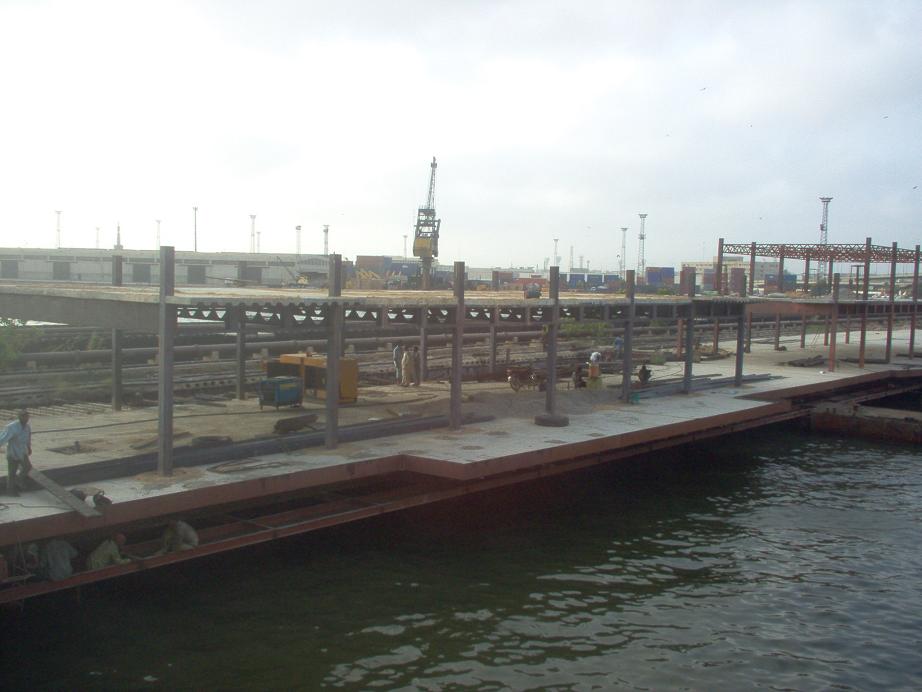
Total Area of berths 6-9 is 220,000 square meters. Berths newly constructed by KPT with a planned depth of 13.5m and quay wall of 600 meters. Pakistan International Container Terminal was formed as the Terminal Operating Company and dedicated container terminal operations commenced on August 9th , 2002. PICT has taken possession of approximately 208,000 square meters of area and completed necessary civil works and office construction for the smooth functioning of the Terminal. The Terminal now possesses dedicated Custom Facilities, Customer Services with one window facilities – including collection of KPT Wharfage dues, Operations Office, Communications Centre and round the clock Private Terminal Security. PICT is providing services to 4 liner shipping lines weekly (on average) and handling container volumes of over 240,000 TEU’s annually.

PICT has 200 Reefer Points Operational and are expanding the capacity further.
PICT has acquired the following new equipment for the timely completion of Phase 1 which was achieved in March 2004:
 

2 Ship-to-Shore Gantry Cranes
4 Rubber Tyred Gantries
          
4 Reach Stackers, 1 Top Lifter
 
2 Empty Container Handlers
      
2 Container Stuffing Forklifts
    
10 Tractor Units
 

20 Trailer Units 
                            
5 Service Vehicles

Clouds started pouring their blessed water in Karachi

 It was such a lovely weather that I couldn’t stop myself from enjoying it and celebrating the beautiful weather with my friends. What could be a better place to visit other than SEA VIEW, the best of the best place in Karachi.
Let me give you an over view of Sea View, it’s actually corniche of Karachi. The moment you reach sea view road, you see beautiful heart throbbing waves splashing and hitting the edge. Lots of people go there to see the sunset, and many even go there to see the sunrise, people jog/walk there and many rich lads bring their horse for horse-riding on seaside (who would miss if one gets an opportunity).
Many bhutta Wala’s, goley gandey wala, Kehwa, Chaye wala are roaming there to serve you. But now there are many take away outlets there that have all the cuisines from Pizzas, burgers, sandwiches, rolls, biryani, juices, coffee, tea etc.
Not to forget Pizza Hut van there, a drive-thru McDonalds, Salt n pepper Village, Floating Boat, etc (hope I didn’t miss any)After sunset, normally people think that it might get dark there and dangerous but let me tell you it’s so bright there, that you might find a dropped common pin because there are so many lamp posts with brighter lights in them and many cops roaming around for security.

It’s a safe and calm place where waves that might seem quiet have so much noise in them that many a times people get afraid of these waves, especially when oil spills in the sea or when there is cyclone news, sea view road gets closed for security purposes. Not to forget, one can’t date there because of our efficient Karachi police. So there is no chance for youngsters to do anything

Tuesday, January 11, 2011

Introduction port qasim

Port Muhammad Bin Qasim is adjacent to the town of the same name in southeastern Karachi, Pakistan, on the Arabian Sea and the delta of the Indus River. Port Muhammad Bin Qasim was constructed in the 1970s to take some of the burgeoning traffic clogging the Port of Karachi. Today, it is Pakistan’s’ second biggest port.Vessels approach Port Muhammad Bin Qasim through a 45-kilometer Navigation Channel that can accommodate vessels to 75 thousand DWT. Tidal variation at Port Muhammad Bin Qasim ranges from 0.5 to 3.5 meters. One of Port Muhammad Bin Qasim’s advantages its location near the national highway network (the National Highway is 15 kilometers away), the rail network (the National Railway is 14 kilometers away), and air transport (22 kilometers from Jinnah International Airport). The National Railway has six tracks immediately behind the berths.
Port Muhammad Bin Qasim contains nine berths that handle cargo. It contains a multi-purpose terminal with four multi-purpose berths, each 200 meters in length. The Qasim International Container Terminal has two berths, each 300 meters long. The Engro Vopak Chemical Terminal has one berth. Pakistan Steel Mills uses the 279-meter-long Iron Ore and Coal Berth. The Fotco Oil Terminal has one berth but has room to add another four.
Port Muhammad Bin Qasim’s International Container Terminal contains two container-handling berths that were converted from four former multi-purpose berths. The terminal is the country’s first dedicated international container terminal, and it has been operating since mid-1997. The terminal covers 240 thousand square meters and has capacity to handle 360 thousand TEUs per year. It can accommodate vessels to 272 meters long and up to 45 thousand DWT. The terminal has rail-mounted ship-to-shore gantry cranes.
Working with Pakistan GasPort, Port Muhammad Bin Qasim is adding a floating Liquefied Natural Gas Terminal that will handle 3 million tons per year and accommodate vessels to 75 thousand DWT. Initial detailed surveys have been completed, and the project is scheduled to be completed in late 2010. The M/s Granada Group of Companies is planning a new specialized Liquefied Natural Gas Floating Terminal that will handle 3.5 million tons per year. Technical proposals are being evaluated.
Port Muhammad Bin Qasim is adding a dedicated Coal, Clinker/Cement Terminal that will handle 4 million tons per year and accommodate vessels to 75 thousand DWT.
Port Muhammad Bin Qasim is also planning to add a second Oil Jetty to handle products from the proposed Indus Oil Refinery. The jetty will have capacity for 9 million tons per year and will accommodate vessels to 75 thousand DWT.
Pakistan Steel Mills has requested a second Iron Ore and Coal Berth at Port Muhammad Bin Qasim. The port is planning to add a facility, to be synchronized with expansions of the steel mills, with capacity for 8 million tons per year that can accommodate vessels to 75 thousand DWT. Port Muhammad Bin Qasim is completing construction of a new Liquid Cargo Terminal to handle up to 4 million tons per year. Covering an area of more than 16.5 thousand square meters, the terminal will accommodate vessels to 35 thousand DWT.
Scheduled for completion in 2010, Port Muhammad Bin Qasim is adding a second container terminal with capacity for almost 1.2 million TEUs under an agreement with Dubai Port World. Covering an area of 250 thousand square meters, the terminal will support 6000-TEU container vessels.
In addition to these projects, Port Muhammad Bin Qasim is undertaking improvements at the port that include deepening and widening the navigation channel and completing the computerization systems supporting port operations.
Port Muhammad Bin Qasim’s Fotco Oil Terminal has operated since 1995. This state-of-the-art, environmentally-friendly terminal can handle 9 million tons of furnace oil per year, and there is room to add three more berths that would raise its capacity to 27 million tons per year. The facility’s jetty can accommodate vessels to 75 thousand DWT, and the terminal can berth tankers to 63 thousand DWT. Since it opened, the terminal has handled more than 29 million tons of furnace oil. In early 2001, it started handling white oil, and it has handled British Petroleum crude oil. Anticipating growth in Pakistan’s future needs for petroleum, the terminal can have four more berths and product pipelines. In addition, Port Muhammad Bin Qasim has set aside over 31 hectares of land for a POL Storage Tank Farm.

Activity at Port Qasim

KARACHI: Brisk shipping activity was observed at 0the Port Qasim where five ships carrying containers, rice and furnace oil were berthed at Qasim International Containers Terminal, Multi Purpose Terminal and FOTCO Terminal respectively Tuesday.
Meanwhile four more ships carrying containers, general cargo and furnace oil also arrived at outer anchorage of Port Qasim on same day.
Berth occupancy was 90 percent at the Port where a total of eleven ships were engaged at PQA berths to load/offload containers, rice, sugar, seeds, canola seeds, furnace oil and palm oil respectively during last 24 hours.
A cargo volume of 10,1680 tonnes comprising 81,535 tonnes imports and 20,145 tonnes exports inclusive of containerized cargo carried in 2,148 containers (TEUs) was handled at the Port during last 24 hours.
Three containers ships sailed out to sea on early morning, while two more ships are expected to sail later today till 12 noon.
Two containers ships and one general cargo ship are expected to take berths at Qasim International Containers Terminal and Multi Purpose Terminal on Wednesday. Shipping activity remained active at the Port Qasim where two ships carrying edible oil and chemicals were berthed at Liquid Cargo Terminal and Engro Vopak Terminal respectively Monday. Meanwhile five more ships carrying containers and furnace oil also arrived at outer anchorage of Port Qasim on same day. Berth occupancy was maintained at the Port at 70 percent on Monday where a total of eight ships were engaged at PQA berths to load/offload rice, sugar, seeds, chemicals and palm oil respectively during last 24 hours.

PAKISTAN INTERNATIONAL CONTAINER TERMINAL

Total Area of berths 6-9 is 220,000 square meters. Berths newly constructed by KPT with a planned depth of 13.5m and quay wall of 600 meters. Pakistan International Container Terminal was formed as the Terminal Operating Company and dedicated container terminal operations commenced on August 9th , 2002. PICT has taken possession of approximately 208,000 square meters of area and completed necessary civil works and office construction for the smooth functioning of the Terminal. The Terminal now possesses dedicated Custom Facilities, Customer Services with one window facilities – including collection of KPT Wharfage dues, Operations Office, Communications Centre and round the clock Private Terminal Security. PICT is providing services to 4 liner shipping lines weekly (on average) and handling container volumes of over 240,000 TEU’s annually.

Monday, January 10, 2011

Death fish

The dead fish started appearing on Saturday afternoon but by Sunday evening, the number of fish has increased alarmingly,” said Keamari Town UC-4 Councilor Abdul Ghani. He added that it was not just dead fish but dead turtles that were being spotted in this area as well.
The mysterious arrival of thousands of dead fish of different sizes into the backwaters of the Karachi harbor, near Baba Island and Bhitt Island, late Saturday night, has created panic among fishermen but the Karachi Port Trust authorities have said they died in the annual Red Tide phenomenon.
Resident of Shamspir village, Suliman, blamed the harbor authorities for allowing deep sea trailers to take all the fish in the open sea, leaving the local fishermen with no choice but to fish on the polluted shores. “We don’t know what to do and how to earn our livelihood in such conditions. Many of us are thinking of changing our profession,” he said.
However, KPT officials rejected the fishermen’s claims that the fish died of toxic chemicals. “This is the work of the Red Tide, locally known as ‘Mara Pani (The killer water).’ It is a normal phenomenon and happens several times a year. There is no need to panic,” said the Karachi Port Trust (KPT) Marine Pollution Control Manager, Muhammad Zahiya Usmani. He also rejected that the fish died in the harbor limits.
“The fish died because of the high tide, outside of the harbor, and then came within the harbor limits with the tide,” said Usmani. Rejecting claims of industrial poisoning, he said that heavy layer of poisonous red algae that forms during a specific period every year, comes to the surface and attracts the fish. When the fish come in contact with the red algae and try to eat it, they die. This happens a lot but this time the high tide has brought the dead fish to the surface,” he said

Wednesday, December 29, 2010

Geographical position of pakistan

Introduction
In this blog we discussed over the coastal position in region...
Pakisan have a big area with covered sea
Later  we discussed over it ................